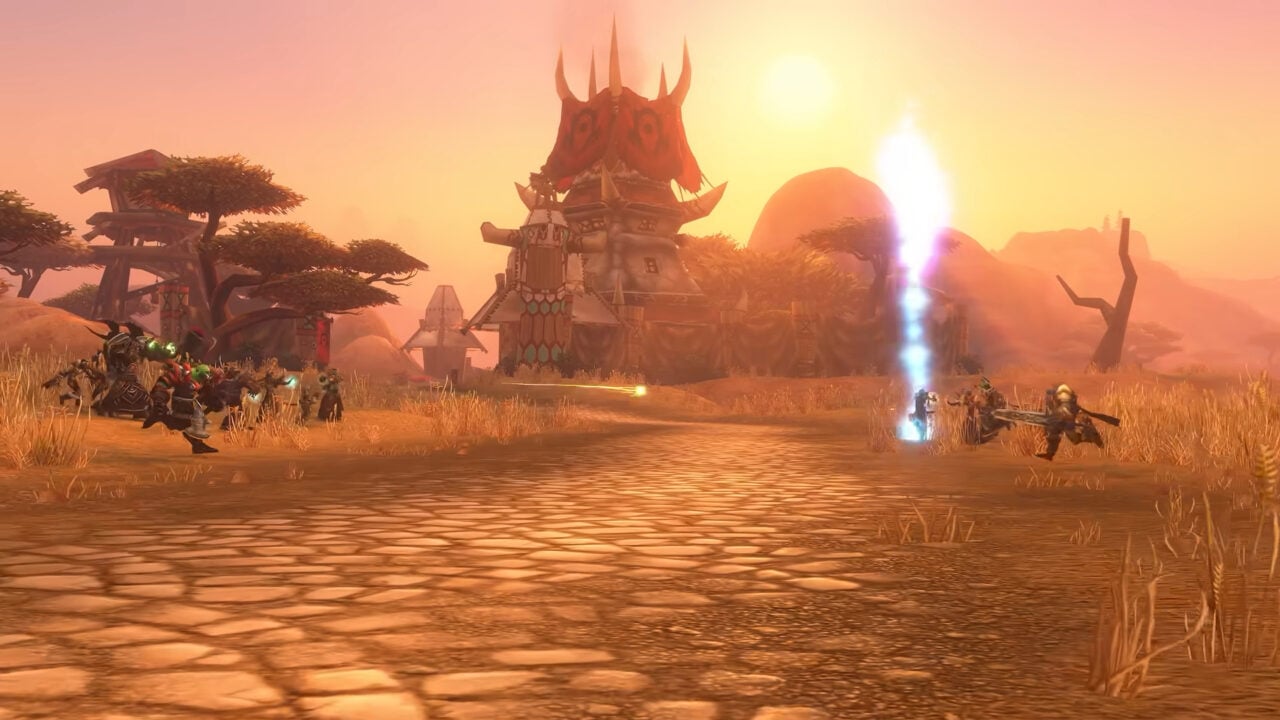
Warlock: Dungeons & Dragons ditches the quest and objective waypoints seen in many large games, and even lets you disable its small compass, to prioritize organic exploration. It's music to my ears.
General manager Dominic Guay of Warlock developer Invoke Studios spoke to IGN about the game's approach.
"We wanted them to engage with the world, to figure things out and feel that when they found things, it was based on their actions and not just blindly trusting a waypoint,” he says.
Guay, like the other former Watch Dogs developers at Invoke, speaks from experience. With a "heavy-handed guiding approach," he says, "a lot of players will just blindly follow the waypoint, and then you lose that agency, you lose that feeling of curiosity."
Before the launch of Red Dead Redemption 2, players gathered around a rumor that Rockstar had added pro-exploration settings that would disable waypoint-like hints and add additional, grounded clues into the game's world, like NPC comments or map details. Warlock uses a system that sounds a little bit like that.
As Guay explains, "Mysteries" can be uncovered through exploration and various interactions. "Not only are there multiple entry points, but depending on how you stumble upon them, it might change how you interact with them," he says. My read is that it's sort of an inverted tree structure: lots of branches to find, all leading back to the core.
This discussion on player agency and direction comes as Marvel's Wolverine, the latest from Insomniac Games, fields criticism of overdone guidance. Amidst the discussion, Insomniac says "we have been 100% listening" and "cooking hard today in response to some of the feedback." (Our own Marvel's Wolverine review mostly docks the game for messiness in its story and features, with combat never becoming good enough to carry the experience.)
Last month, we got a fresh, extended look at Warlock gameplay. Very different from D&D standard-bearer Baldur's Gate 3 and with hints of Dragon's Dogma 2, the game is shaping up to be, if nothing else, interesting.
Upcoming Mass Effect-like RPG Exodus takes romance seriously, which means you'll need to get comfortable with the idea that serious romance requires sacrifice, and, sometimes, a pig pen of mess. You'll be able to date around, but not without consequence.
Exodus narrative director – and Mass Effect's lead writer – Drew Karpyshyn tells Game Informer that romance was mandatory for the sci-fi drama because "it would feel almost hollow" without it. "Romance is a huge part of the real world," Karpyshyn adds, and Exodus encourages you to be reasonable when you feel a familiar spark in-game.
So while "you can have multiple romances going at the same time," Karpyshyn says, "eventually, there might be some issues with that, depending on which companions [you choose]."
It's like any other situation where one partner wants to discuss non-monogamy and the other wants to throw their copy of The Ethical Slut into a funeral pyre. Basically, "Not everybody is comfortable with that," Karpyshyn says, "and as the story develops, your romance might go from something like a casual relationship, more of a fling, to something much deeper."
"In that case," the writer says, "most of the companions would not want you to have a very deep emotional connection with somebody else as well." You may choose to ignore your lovers' wishes if you'd like to live your life in space as an evil bachelorette, but keep in mind that Exodus' romance is connected to its affinity system. So, the more you risk your tires getting slashed – or whatever the intergalactic equivalent of that is. Your rocketship will get keyed.
(Image credit: Archetype Entertainment)
Even mission scenarios can risk pissing off your partner. Karpyshyn explains, "You might get into a situation where you think, 'Well, for this mission, I actually agree with this character, but I've been romancing this character. Should I just back them anyway?"
"If you do," the writer continues, "that'll obviously get you more affinity with that character." But "if you decide not to back the character," he warns, "you might get yourself into a situation where they are not very happy with you. I'm sure anyone who's been in a relationship has experienced that."
Karpyshyn explained to GamesRadar+ in February that playing as the main character doesn't give you magic heartthrob status. Its approach to relationships, as I'm sure you've been starting to pick up on, is more realistic than that. The narrative lead said at the time, "There are some games where, literally, you can just romance anyone, because you're the hero, and you just get it." Exodus doesn't waste its time with something so easy.
"We want it to be a little bit more than that. We want these relationships to feel real, which means there's sometimes conflict, there's sometimes push and pull. Sometimes you've got to earn it" – something you should keep in mind for your time both in space and on Earth.
Destiny's Taken King expansion is officially 11 years old, and former Bungie studio vice president Mark Noseworthy marked the occasion by saying what many Destiny players have thought a million times: this game is so good, but it could be so much better.
In a post on Twitter, Noseworthy, who left Bungie in 2024 along with some other senior staff amidst layoffs, describes The Taken King as his personal pinnacle.
"Of all the parts of Destiny I’ve worked on, this remains my personal favorite as a player and the one I’m most proud of," he reflects. "We knew Destiny 1 was so close to great; it was just missing some ingredients and a different preparation. 'I love playing Destiny. I hate that it’s not better' was our mantra while making [The Taken King]."
The early days of Destiny were some of the series' messiest, with players and Bungie both unsure of what the game was meant to be. The Vault of Glass, the first raid, helped crystallize the vision and, frankly, resuscitate the game, but it was The Taken King – a blast of new content, an immeasurably stronger story, added buildcrafting options, and improved progression and endgame pursuits – that really pushed the game over the top. This is what Destiny can be.
(Image credit: Bungie)
The Taken King is still remembered as one of the best expansions in Destiny's history – to some, the best, though I personally put it behind The Witch Queen and, at the top, The Final Shape. (It's no coincidence that most of the best expansions are Hive-themed, as the Hive have the best lore.) It also cemented a pattern that would come to define much of Destiny's life, and a slightly meaner mantra that many players adopted: I hate Destiny, it's my favorite game.
Throughout its life, Destiny has often felt like it's about to turn the corner, with only its finest expansions actually delivering on everything expected or imagined, and avoiding systemic missteps that another expansion would have to fix.
Looking back, a lot of Destiny expansions really were fixers. Destiny 2's Forsaken, for example, was a near shot-for-shot replay of The Taken King: after a troubled launch, Bungie stepped in to correct a bunch of errors. That became my acid test for expansions: how much of this is fixing Destiny, and how much of this is celebrating or expanding it? Is the game great now, or could it be great later?
The final update for Destiny 2, stuck in stasis after Bungie ended active development and began to really prioritize digging Marathon out of its rut, left it in arguably the best place it's ever been, with FOMO removed, loot updated, and many events available. But with the end of development, the game also stopped chasing those new horizons. We'll never turn the corner now.
A full five years after its announcement, Marvel’s Wolverine is finally out on PlayStation 5. What should be a triumphant moment for Sony, though, has turned out to be an unexpected headache. Uneven reviews, a particularly loud peanut gallery, and close proximity to multiple unpopular business decisions have turned what many assumed would be a surefire bet into a strangely toxic game release.
Here's a neat thought: One of the most popular multiplayer games on the planet right now has no matchmaking button. FPS fans are flocking to Wardogs for its fresh ideas around teamwork, economy, and "all-out warfare." It's pulling in the largest crowds this sort of round-based, milsim-y FPS (a category that also includes Squad and Hell Let Loose) has ever seen.
It's very much filling the Battlefield-shaped hole in my game time, and that's in no small part due to its server browser.
Man, is it nice to press play on a main menu in 2026 and get options like this:
BulkheadBulkhead
Check out that beaut: A complete list of official servers in my region, sortable by players, ping, rulesets, and maps. And would you look at that: A prominent community section featuring persistent servers rentable from third-party vendors.
No forced matchmaking. No skill-based algorithms. No disbanding lobbies (in community servers, at least). This is exactly the sort of convenient, community-forward setup that still appears regularly in niche milsims and indie shooters, and one that fans have been begging Battlefield to get back to.
(Image credit: Team17)
It was around this time last year that EA was making a big to-do about Battlefield 6's community server support. Devs insisted that the Portal server browser, which doesn't support third-party server providers and instead allows players to spin up one semi-persistent lobby at a time, would "tick every box" for a proper server browser.
It did not: At launch, Portal servers were buggy, dominated by XP farming lobbies, and buried under a pile of Netflix menu tiles. As plenty of us predicted, interest in the Portal browser as an alternative to official matchmaking quickly died out, and now it's only good for goofy minigames and, somehow still, XP farming.
(Image credit: EA)
When asked at the time why Battlefield 6 couldn't just have a real browser—the kind that lets you see all of the official servers as well as community-hosted ones—DICE lead producer David Sirland offered an answer that, in retrospect, is pretty weak sauce.
"Matchmaking servers spin up in seconds (get filled with players), and spin down after the game is over. That couple of seconds, plus when servers lose a lot of players, mid-game is the only time you can join, which makes it a tricky combination (and full of queuing to join issues)."
And yet, here we are: Wardogs has millions of players, and they seem to be navigating those "issues" just fine. Even the supposed drawbacks of manual browsing are barely a thing in Wardogs. There are currently so many official and community servers that finding one with a few spare slots takes seconds, and players cycle in and out of the 100-player matches so often that queues are rarely a long wait.
(Image credit: David Sirland on X)
Meanwhile, the benefits are obvious: Community servers have admins that can punish cheaters and griefers faster than automated tools, and when they're allowed to flourish, these servers can be recognizable social spaces with regulars and customs. Developer Bulkhead isn't doing anything unique here, just what most PC shooters did 20 years ago.
The reality is that pulling off a server browser really comes down to will. Battlefield 6 doesn't have a real, prominent browser because EA doesn'tdon't want one. DICE built it like a console game (really, like Call of Duty) with algorithmic factors that get thrown off when folks can just hop into whatever server they want. So Portal was the compromise—a walled garden with restrictive, fake-persistent access to dedicated servers. It was a miscalculation about where the wind is blowing in the FPS scene, and it's still hurting an otherwise great game.
Wardogs' server browser is far from flawless. Basic features like favoriting and tiered queueing are still on the way, joining a server as a group is harder than it should be, and server admins are missing crucial tools—but it's a strong start for an early access game, and immediately more legitimate than Battlefield 6's sorry excuse for community support. In more ways than one, Battlefield could learn from Wardogs and smaller shooters like it.
It's a sad day for aficionados of undead porn games, but a good one for pretty much everybody else: Valve has rescinded the adults only rating it had applied to the upcoming narrative RPG Nighthawks, meaning it will appear in standard searches on the storefront and won't be blocked from sale in some regions.
"Phew. What a roller coaster," Dave Gilbert, head of publisher Wadjet Eye Games, wrote on Bluesky. "Thank you everyone for your amazing support while we got this sorted. If you weren't able to wishlist before, now you can!"
I tested for myself, and sure enough, Nighthawks now appears in Steam searches even if you're not logged in. Previously, the adult rating meant it wouldn't show up unless you were logged in and had your account set to display AO-rated games.
In a separate post, Nighthawks developer (and former PC Gamer contributor) Richard Cobbett also expressed relief at the change: "Now I can get back to only stressing over people actually liking it!"
Oh, thank goodness. Now I can get back to only stressing over people actually liking it!
The entire situation was bizarre. Nighthawks, a game about life as a new vampire in a world where the existence of vampires is known, began as a 2018 Kickstarter project; it promised depth, complexity, great storytelling, hand-drawn art, and absolutely nothing about sex.
The same is visible on the Nighthawks Steam page: A little sexy, maybe—it's vampires, after all, and you know how they are—but hardcore sex? Not so much.
Vampires, am I right?(Image credit: Wadjet Eye Games)
Complicating matters further, Cobbett told us when the AO rating was first imposed that nobody was really sure what had caused it. "Vampires are inherently a bit sexy, and Nighthawks is definitely a mature game in terms of content," he said over the weekend. "However, regarding nudity, sex, and similar elements specifically, it's really all very mild, usually comedic in tone when it happens, and far less explicit than anything you'd see on HBO."
Why exactly Valve walked the rating back is also a mystery. Gilbert told me in a chat today that Valve didn't give him any "clear insights" into the initial rating, or why it was changed. He did say, however, that "Valve was very helpful in expediting the review on my appeal so we could get the AO rating dropped and the game itself approved for release. Regardless of how and why it happened, they did everything in their power to make it right. So I’m very grateful for that."
The experience of the surprise AO rating was very stressful, Gilbert said, and he was "basically swimming in cortisol" throughout. But he also acknowledged that, with the resolution in place, it was a "net positive" overall, and that the number of wishlists on Steam had "basically doubled overnight."
"I did not expect the whole thing to go as viral as it did. It called a lot more attention to the game that I am normally capable of on my own," he said. "I wish I could say I planned this as a guerrilla marketing stunt, but I’m not that dumb and I’m not that smart!
"I have no illusions that all of those new wishlists are sincere, and that a nonzero chunk of them aren't 'protest wishlists,' but anything that pushes the algorithm into thinking we are popular isn't a bad thing."
With "a decent night's sleep" behind him, Gilbert said he can see the humor in the situation, adding that he'll "be dining out on this story for a long time." He also recognizes, though, that he was very lucky to get the outcome he wanted, as quickly as he did.
"I had the contacts and the fanbase and the (relative) clout to make a bit of noise and get this handled quickly. Many devs in the same situation wouldn't be able to do that," Gilbert said. "At the very least, this has shed a big light on the problem and made Valve aware that this is a big problem many indies face. Hopefully it means that others will have an easier time of it going forward."
Classifying Nighthawks as a hardcore sex game does put a light on the imperfections (and frustrating opacity) of Steam's rating system (and yeah, now that we've got a happy ending we can admit it's kind of funny too), but the sheer number of games on the storefront means change to its classification system may be unlikely: More than 19,000 new games launched on Steam in 2025 alone.
Nighthawks is set to launch on September 22. and alongside Steam will also be available on GOG.